What you’ll learn in this article:
- Loose parts play sparks creativity and imagination by encouraging children to use materials in endless ways.
- Loose parts can include natural objects, household items, and repurposed materials.
- The developmental benefits of loose parts play include improved problem-solving, language, motor skills and independence.
- We incorporate sustainable loose parts play across all age groups to enrich children’s learning experiences.
- You can try loose parts play at home through building, storytelling and arts and crafts activities.
What is loose parts play?
Loose parts play in early learning allows children to explore, experiment and develop their creativity by playing with open-ended materials. These could be materials found in nature or simple household objects – anything that can be moved, combined, redesigned or taken apart in different ways.
A cardboard box might become a spaceship, castle or secret hideout, while pebbles and shells could turn into characters for an elaborate story. The possibilities are endless!
Loose parts play not only sparks joy and fun for children, but it also builds skills across all areas of their development, from problem-solving to motor skills. This makes it an important part of early childhood education, which is why we encourage it at our early learning centres.
The theory of loose parts play
The concept stems from architect Simon Nicholson's ‘Theory of Loose Parts’ from 1971. Nicholson wrote that ‘in any environment, both the degree of inventiveness and creativity, and the possibility of discovery, are directly proportional to the number and kind of variables in it.’
Put simply, the more opportunities children have to play with different things in different ways, the more they will be able to use their imagination and creativity.
For example, playing in an outdoor environment allows children to discover materials like branches, stones and leaves. They might build structures out of rocks, use a twig as a magic wand, create art displays with flowers, or invent stories about an inspect they’ve spotted. The outdoor environment provides children with a lot of freedom and possibility, making it more likely that they will develop their creativity and discover new things.
On the other hand, if children only have access to toys that must be used in a single, specific way, there are fewer opportunities for them to use their imagination or develop their creativity.
Nicholson’s theory was highly influential in the childcare and education industry. Rather than filling learning environments with single-purpose toys, educators began recognising that simple, versatile materials could offer far richer learning opportunities.
Examples of loose parts play materials
The magic of loose parts lies in their endless possibilities and accessibility. You don't need expensive objects or materials. Some of the most engaging loose parts which we use across our centres can be found in nature or around your home.
Natural objects
- Pinecones, acorns and seeds
- Shells, pebbles and smooth stones
- Feathers, leaves and twigs
- Flowers and petals
- Logs, branches and bamboo poles
- Large rocks and boulders
- Tree stumps and wooden planks
- Sand, water and mud
Household items
- Buttons of various sizes and colours
- Wooden spools and beads
- Ribbons, fabric scraps and yarn
- Bottle caps and jar lids
- Wooden pegs and clothes pins
- Cardboard boxes of various sizes
- Plastic containers and buckets
- Wooden blocks and planks
- Sheets, blankets and cushions
Repurposed materials
- Egg cartons and cardboard tubes
- Small boxes and containers
- Wine corks and wooden blocks
- Tyres and inner tubes
- Milk crates and storage boxes
- Wooden pallets (safely prepared)
The benefits of loose parts play
- Creativity, curiosity and imagination:With unlimited possibilities, children develop innovative thinking skills and learn to see potential in everyday objects.
- Problem-solving and critical thinking: Children learn to experiment, test ideas, evaluate results, and adjust their approaches – essential skills for lifelong learning.
- Language and literacy development: Loose parts play encourages children to describe their creations, negotiate roles with peers, and develop their vocabulary through hands-on experiences.
- Physical development: Children can develop fine motor skills improve through sorting and arranging small objects, while developing gross motor skills through building and construction activities.
- Social interaction: Loose parts play encourages cooperation and cooperation, as children share ideas and work towards common goals.
- Independence and autonomy: As they play, children can explore their own ideas and make decisions about how they use loose parts. This builds their confidence and self-reliance.
- Connection with nature: Many loose parts are natural objects or materials. This deepens children’s environmental awareness and appreciation for the natural world around them.
- Focus and engagement: Research shows that loose parts hold children’s attention for longer than structured toys, leading to more meaningful learning experiences.
How we embrace loose parts play in our early learning centres
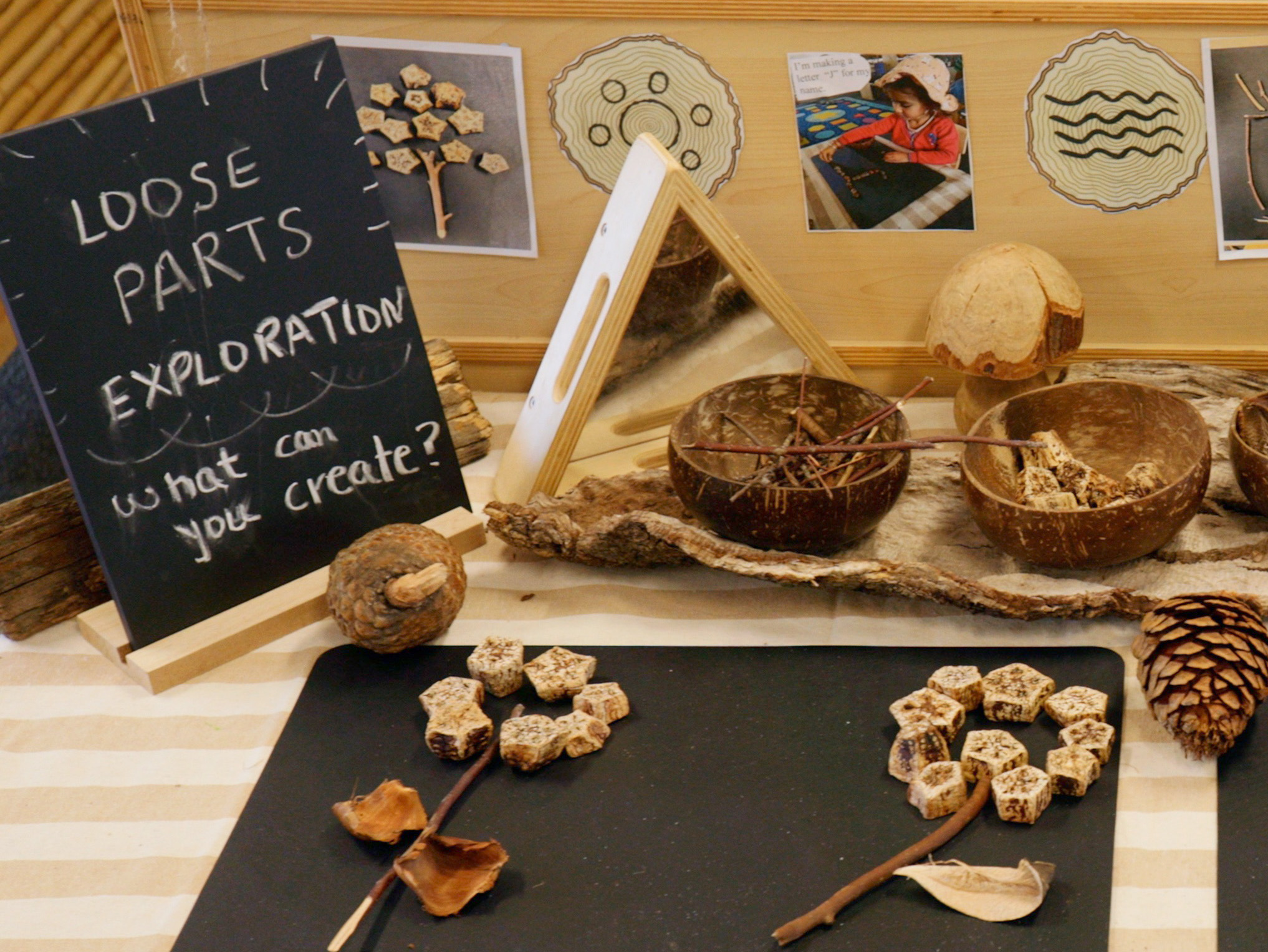
At the Y, we integrate loose parts play across all age groups. We focus on using sustainable and natural materials like pinecones, wooden objects, stones, leaves, branches and more. We see firsthand how exploring different textures, weights and materials encourages children to develop their creativity.
We regularly refresh and rotate materials, and introduce new challenges to keep children engaged, having fun and learning new things. In the image below, you can see how some of our children used loose parts to create fantastic art pieces.
Ideas for parents: How to bring loose parts play home
Creating opportunities for loose parts play at home doesn't require special training or expensive materials. Here are some simple ideas to start with:
Building and construction activities
- Create towers using blocks, containers and natural materials
- Build bridges and ramps with wooden planks
- Construct enclosures and boundaries using sticks or stones
Sorting and counting games
- Sort objects by colour, size, texture or material
- Create patterns using different loose parts
- Practise counting objects to develop numeracy skills
Creative storytelling
- Use different objects as characters in imaginative stories
- Create small worlds and landscapes with a variety of materials
- Develop narrative skills through play scenarios
Artistic exploration
- Arrange materials to create drawings and art pieces
- Experiment with colour, texture and form
- Explore symmetry by finding objects that look alike
Safety considerations
- Choose age-appropriate sizes (use larger loose parts for younger children to prevent choking hazards)
- Avoid materials with sharp edges or toxic substances
- Regularly clean and inspect materials for wear or damage
- Provide supervised exploration, especially when introducing new materials
- Store materials safely when not in use
Discover loose parts play at the Y
At the Y Early Learning, we embrace loose parts play across all age groups, using sustainable materials to create enriching learning experiences. It’s a fantastic way to spark creativity, imagination and skill development in children.
To learn more about loose parts play or see our early learning centres in action, you’re welcome to book a tour. Come along and see how we’re empowering young minds through creative, purposeful play!